
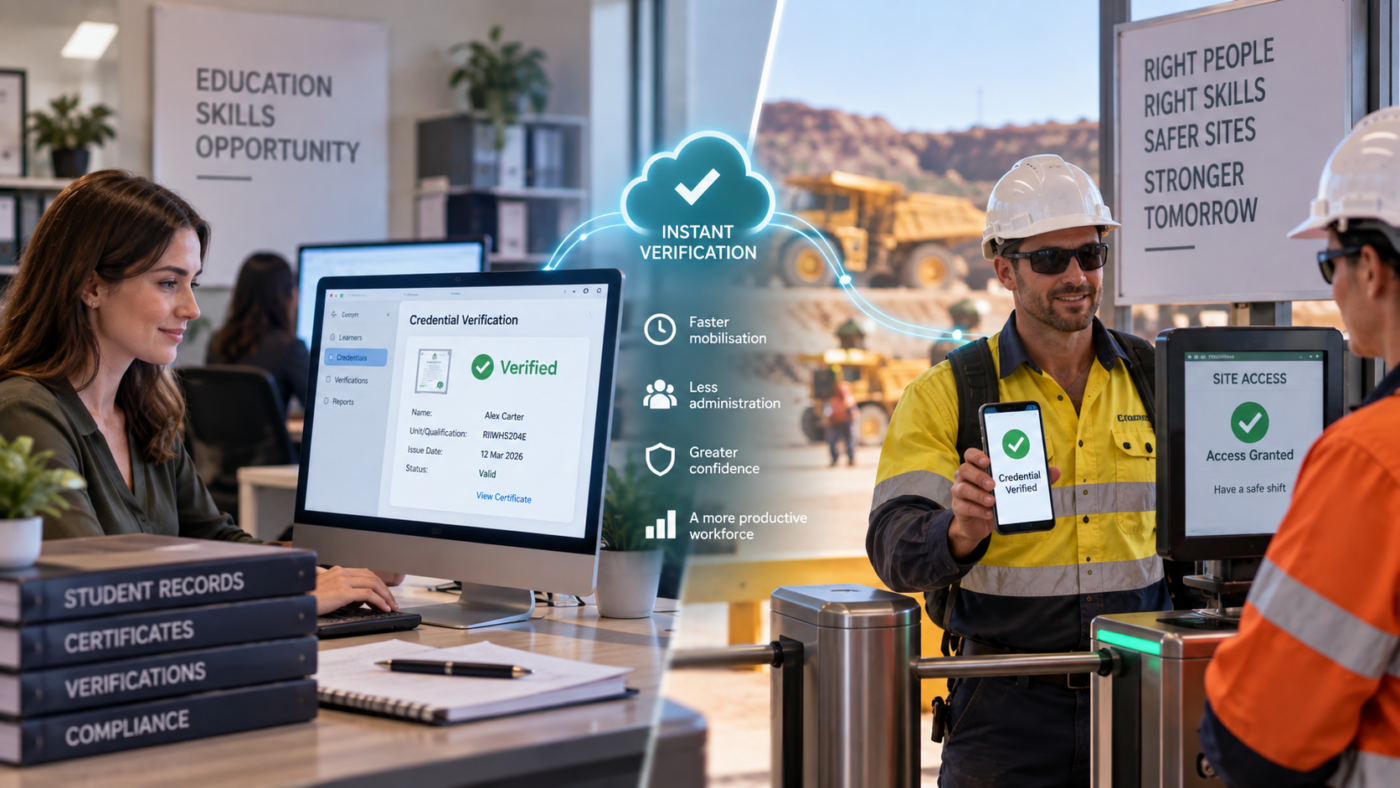
Every Verification Call Is a Cost You’re Not Tracking
RTOs in high-compliance sectors like mining spend real staff time on a problem that has nothing to do with training delivery: proving a certificate is genuine. An employer or recruiter calls, someone pulls the record, checks it against what the candidate presented, and confirms it by phone. Multiply that by every mine site, labour hire firm, and hospital that hires your graduates, and it adds up to hours of admin time that produces no training outcome at all.
The fix isn’t more staff. It’s removing the phone call.
The visibility you weren’t getting from phone calls
A self-service verification process does more than kill the phone queue. Every request gets logged, which means the RTO can see which companies are actually verifying its students’ certificates, not just who called to ask.
That log turns into a straightforward view of recruiter activity over time: which companies are hiring your graduates, how that’s trending month to month, and where there might be an opening to engage directly, whether that’s a conversation about their ongoing needs or a group training arrangement. Data you were previously fielding one phone call at a time becomes something you can actually act on.
Why this matters beyond the admin saving
Certificate fraud and misrepresentation are a real risk in industries where a missing competency can mean a safety incident. Making verification self-service doesn’t just save your staff time, it makes checking the default behaviour for every employer and recruiter, because it’s now easier than not checking. That’s a meaningful shift in a sector where the cost of an unverified, invalid credential is measured in safety outcomes, not just compliance paperwork.
For RTOs already issuing large volumes of statements of attainment, this is a low-effort addition: no change to how certificates are issued, just a QR code and a link doing quiet, continuous work in the background.
The TUTIS Solution
TUTIS_TRAIN’s Certificate Verification option puts a QR code and link directly on the certificate template. When a recruiter or employer wants to confirm authenticity, they scan the code or click the link, which takes them to a verification portal with the document number pre-filled.
From there:
- The recruiter enters their email address.
- The system checks the certificate against its records. If nothing matches, it returns an error immediately, no RTO staff involved.
- If the certificate is genuine, the system emails the recruiter a secure link to the original certificate image, so they can compare it directly against what the candidate handed them.
Certificates that have a correction history remain fully auditable. All prior versions are visible through the same portal, so RTOs aren’t just verifying the current document, they’re verifying its full provenance.
In short, TUTIS_TRAIN gives RTOs:
- A QR code and link added directly to the certificate template, no change to issuing process
- A self-service portal where recruiters and employers verify a certificate without calling the RTO
- Automatic email delivery of the original certificate image once a match is confirmed
- Full correction history available for audit, not just the current version
- A verification log showing which companies are recruiting your students, viewable directly in TUTIS
The result: fewer verification calls, a lower risk of unverified credentials slipping through, and recruiter data the RTO can actually use.
Interested in adding Certificate Verification to your TUTIS_TRAIN setup? Reach out to hello@tutis.com.au