
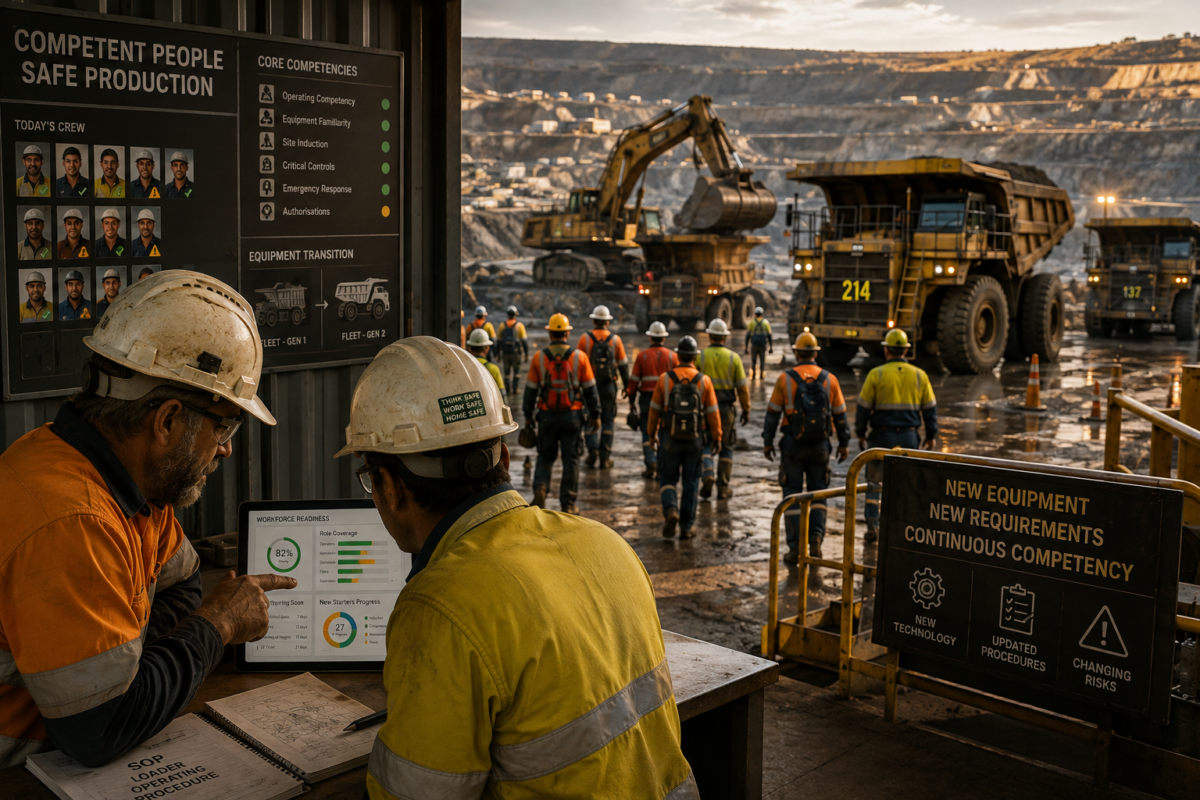
The Workforce Is Changing. So Is the Work.
Maintaining workforce competency in mining is difficult for a simple reason: neither the workforce nor the work stays still. With operations experiencing annual turnover in the 20–30% range, a significant portion of the workforce may need to be onboarded, verified and brought to the required level of competency every year, with contractor workforces often changing even faster. At the same time, equipment is replaced, procedures are revised, roles evolve and production requirements change. Mining companies are therefore not maintaining competency against a fixed target. They are continually trying to keep a changing workforce aligned with a changing operation.
Turnover Keeps Resetting the Capability Picture
Long-running University of Queensland mining research illustrates the scale of that challenge. Research referenced by UQ involving around 4,700 Western Australian mining workers found that 19.6% had less than 12 months’ service at their current site. Among mine and plant operators and trades, approximately one-third had been at their current mine for less than 12 months. For an industry dependent on site-specific knowledge, practical competence and high-risk work requirements, that level of workforce movement matters.
Every New Worker Creates a Capability Requirement
A new worker arriving at a mine may already be highly experienced and appropriately qualified, but that does not automatically make them ready for every task at that site. Competencies need to be verified. Site requirements need to be understood. Authorisations may need to be completed. Equipment familiarisation, inductions and practical assessments may also be required. When this process is occurring across a significant percentage of the workforce every year, maintaining Mining Workforce Competency becomes a continuous operational activity rather than an occasional training exercise.
The Machinery Does Not Stand Still Either
While people are moving through the operation, the equipment and processes around them are changing as well. Mobile plant is upgraded or replaced. Fixed plant changes. Controls and interfaces evolve. Procedures are rewritten following operational improvements or changes in risk. A worker who was proficient on one piece of equipment cannot simply be assumed to have the same level of proficiency on its replacement. The qualification may still be valid, but the practical capability required to operate safely and productively may have changed.
Competency Is a Moving Target
This is the central difficulty. A mine may successfully establish competency across its workforce today, but tomorrow the workforce composition changes, a new contractor arrives, equipment is upgraded or a work method is modified. The competency picture changes with it. Workforce Competency Management therefore cannot rely solely on historical training records or periodic reviews. It needs to provide a current view of what people are competent to do, where further development is required and whether that capability matches the work the operation is actually planning.
Qualification Alone Does Not Guarantee Proficiency
There is also an important distinction between holding a qualification and being proficient in the work being performed. A worker may meet the formal requirement for a role while still requiring experience with a particular machine, site procedure or operating environment. Another worker may have extensive practical experience but need an updated assessment or authorisation before being deployed. Good competency management makes those differences visible rather than treating every completed requirement as equivalent.
The Cost Appears at the Workfront
When workforce capability and operational requirements fall out of alignment, the effects are practical. Work may need to be reassigned. Supervisors spend more time verifying requirements or finding substitutes. Workers may require additional supervision before performing independently. Contractors can arrive onsite only for a missing requirement to be discovered before work begins. None of these situations necessarily represents a major failure, but repeated across shifts, crews and sites, they create friction that affects productivity.
Safe Production Depends on the Same Alignment
The safety case is equally important. Safe production relies on more than having enough people on the roster or enough completed training records in the system. It depends on workers being genuinely competent and proficient for the equipment, task and conditions in front of them. As machinery and procedures change, competency must change with them. As new workers enter the operation, their capability needs to be established before assumptions reach the workfront.
The Goal Is Not More Training
This does not mean sending more people through more courses. In many cases, the organisation may already have much of the capability it needs. The challenge is knowing where that capability exists, whether it remains current and what specifically needs to be developed. Effective Workforce Competency Management should help distinguish between someone who requires substantial development and someone who may only need familiarisation, verification or one additional competency to become fully deployable.
Visibility Makes Change Easier to Manage
A clear view of workforce proficiency also allows operational change to be planned more effectively. If new equipment is being introduced, the organisation can identify who needs development before commissioning. If a procedure changes, affected roles can be identified early. If turnover is reducing capability depth in a critical role, additional workers can be developed before the shortage affects production. Competency information becomes more valuable when it helps operations anticipate the impact of change rather than document it afterwards.
Workforce Competency Becomes a Production Control
This is where systems such as TUTIS can support a broader operational objective. Bringing competency requirements, evidence, assessments, onboarding and workforce proficiency into a connected view gives mining organisations greater confidence in who is ready for what work. It supports earlier identification of gaps, more targeted development and better deployment decisions without compromising the standards required for safe production.
Keeping Capability Ahead of Change
Mining workforces will continue to change. Contractors will move between projects, experienced workers will leave and new employees will arrive. Equipment, processes and operating requirements will continue to evolve as well. The challenge is not preventing that change. It is maintaining the workforce capability required to absorb it.
For mining organisations, that means treating competency as something that must continuously move with the operation. When workforce proficiency keeps pace with changing people, machinery and work requirements, the result is greater confidence in the production plan, fewer avoidable capability constraints and a stronger foundation for safe, productive execution.
The workforce will keep changing. The mine will keep changing. The challenge is making sure capability never becomes the gap between the two.