
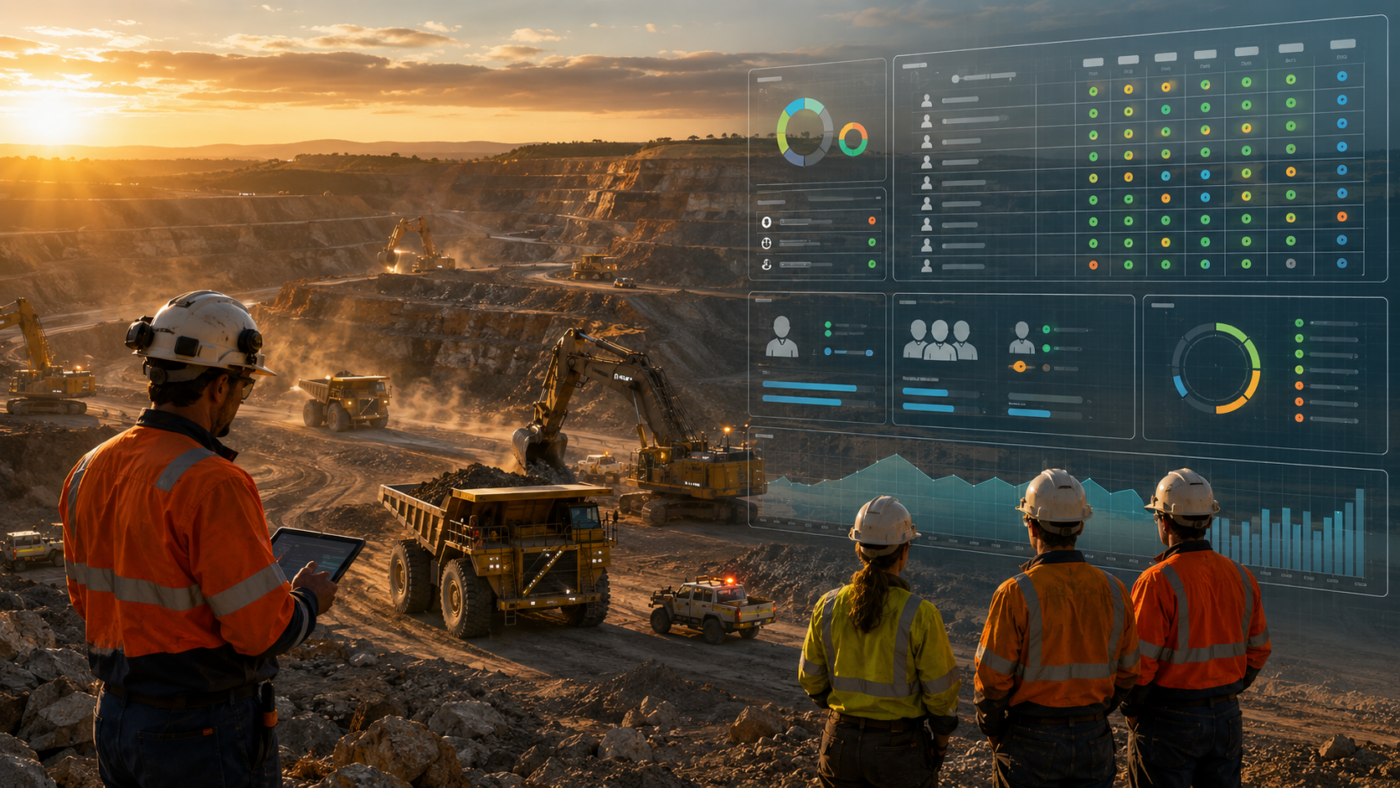
Mining is not a simple workforce environment. It is dynamic, hazardous, highly regulated, contractor-heavy, and constantly changing. A mine site is not a corporate office with a stable workforce, predictable roles and tidy annual professional development plans.
It is an operating environment where the wrong person in the wrong role, with the wrong competency status, can stop work, delay production, increase safety risk, or create compliance exposure.
That is why workforce competency management in mining needs to be treated as an operational system — not simply as a training administration function.
Mining competency is complex by design
Mining operations require many different roles, authorisations, tickets, licences, site inductions, task competencies, equipment qualifications, refresher cycles and supervisor sign-offs. Some capabilities are used every day. Others are seasonal, project-specific, shutdown-specific, or required only when a new pit, shaft, processing plant, conveyor extension or brownfield expansion comes online.
This complexity is increasing. The Minerals Council of Australia notes that the modern mining workforce increasingly requires advanced technical skills, robotics, communications, engineering, data and analytical capabilities — in addition to traditional trades, engineering and operational skills. (Minerals Council of Australia)
At the same time, Australia continues to face persistent workforce and skills shortages. The Mining and Automotive Skills Alliance’s 2025 Workforce Plan identifies short-term challenges including skills shortages, retention issues and declining VET enrolments, alongside long-term shifts such as decarbonisation, electrification, AI integration and critical minerals demand. (Mining and Automotive Skills Alliance)
For mining companies, this means workforce competency is no longer just a compliance record. It is a core operational capability.
The real challenge: many departments, one workforce
A mining worker’s readiness is rarely managed by one department. It typically depends on many functions working together, including:
- General management — annual mine planning and expansion
- HR and workforce teams — workforce planning and review
- Supply and contracts — labour hire and specialist service provider management
- Operations and maintenance — staff and contractor skills review
- Central recruitment — filling skills gaps and replacing turnover
- Training content teams — developing material with operations, maintenance and safety teams
- People logistics — travel, accommodation, camp and journey management
- HSET training — onboarding and induction
- Operations and maintenance — schedules, rosters and swings
- HSET training — refresher training and proficiency upgrades
- HSET safety and compliance — site access control
- Finance — payroll and contractor payment validation
Each function may have its own process. Some may have strong systems. Others may still rely on spreadsheets, paper forms, email trails or manual checks.
The problem is not usually that mining companies do nothing. The problem is that they often do not have end-to-end visibility across the complete worker journey: from workforce planning, contractor engagement and onboarding through to site access, task authorisation, field assessment, refresher management, rosters and payment controls.
Why generic “white collar” LMS platforms fall short
Many organisations have implemented corporate Learning Management Systems designed for professional development, office training, leadership courses, cybersecurity awareness, policy acknowledgement or compliance modules.
These systems may work well for head office. But mining competency management is different.
A generic LMS usually asks: Has the person completed the course?
A mining competency system needs to ask:
Is this person currently competent, authorised, inducted, medically cleared, licenced, verified, rostered, and approved to perform this task, on this site, under these conditions, today?
That is a very different question.
Competency-based training is about bridging the gap between what a worker knows and what a worker can actually do. Frontline training commentary consistently distinguishes between knowledge completion and demonstrated capability, with competency-based approaches focused on task-specific skills, assessment and workplace performance rather than course attendance alone. (L2L)
Mining-focused LMS and competency platforms are therefore different from generic corporate LMS tools. Recent industry commentary on mining LMS platforms highlights requirements such as safety and compliance management, remote operations support, field access, certification tracking and regulatory training features — capabilities that are not usually central to office-oriented LMS platforms. (Cloud Assess)
Site readiness depends on operational competency data
A modern mining organisation needs to know:
- Who is available?
- Who is competent?
- Who is authorised for the task?
- Who needs refresher training?
- Which contractors are compliant?
- Which crews have skill gaps?
- Which upcoming projects will require specialist capability?
- Which roles are exposed if one or two people leave?
- Which workers can access which areas of the site?
- Which competencies are expiring before the next swing or shutdown?
These questions cannot be answered reliably from disconnected spreadsheets, paper assessments and a generic LMS.
The importance of site-specific training is well recognised. SafeWork SA states that mine site induction is an important first step in ensuring everyone at the mine understands how safety will work in practice. WorkSafe WA similarly notes that effective inductions should be tailored and targeted for employees, contractors and trainees, covering the workplace, equipment, materials, processes and tasks workers may encounter. (SafeWork SA)
For contractors, the challenge is even greater. Mining operations often rely on labour hire, subcontractors and specialist service providers. International mining safety guidance also recognises that contractors may require different levels of training depending on their exposure to mine site hazards and the frequency or duration of their work on site. (Mine Health and Safety Administration)
In practical terms, this means mining companies need a system that can manage workers, contractors, roles, competencies, projects, tasks, authorisations, evidence and expiry dates in one coherent operating model.
Competency management is also a productivity issue
Poor competency visibility creates operational friction.
- A worker arrives on site but cannot be cleared.
- A contractor has completed an induction but lacks a task authorisation.
- A shutdown requires a specialist skill that was not identified early enough.
- A supervisor discovers expired competencies only when allocating work.
- A training team is chasing paper evidence while operations are trying to keep production moving.
- A payroll or contractor payment process is disconnected from actual attendance, authorisation or completion records.
These are not just training administration issues. They are productivity issues.
Deloitte’s 2026 Global Human Capital Trends report found that many business leaders now see competitive advantage as depending on speed, adaptability and the ability to orchestrate people and resources quickly as work changes. (Deloitte)
That applies directly to mining. In a changing operating site, competency data must move at the same pace as the operation.
What mining needs instead
Mining companies need competency systems designed around frontline work, not office training.
A fit-for-purpose mining workforce competency platform should support:
- Role-based competency matrices
- Site-specific inductions and access requirements
- Contractor and subcontractor onboarding
- Evidence capture and document control
- Practical assessments and supervisor sign-offs
- Expiry, refresher and reassessment workflows
- Skills gap analysis by site, crew, role or project
- Workforce planning for shutdowns, expansions and new operating areas
- Integration with rosters, scheduling, HR, payroll, contractor management and access control
- Reporting for operations, HSET, HR, management and finance
Most importantly, it should provide one operational view of workforce readiness.
The Tutis view: competency is the link between compliance and performance
At Tutis, we believe workforce competency management should not be treated as a back-office training record.
For mining, competency is the link between:
- workforce planning and production readiness
- contractor management and site access
- safety compliance and operational execution
- training investment and measurable proficiency
- skills visibility and productivity improvement
Mining operations need to know not only who has completed training, but who is genuinely ready to work safely and productively.
That requires a system designed for the realities of frontline, competency-based, contractor-intensive environments.
Generic LMS platforms may manage learning.
Spreadsheets may track fragments of information.
Paper records may satisfy a local process for a time.
But mining organisations need more than that.
They need end-to-end visibility of workforce capability — across staff, contractors, subcontractors, casuals, projects, rosters, sites and changing operating conditions.
That is where a dedicated workforce competency and skills management platform becomes a strategic operational tool.
At Tutis, we believe workforce competency management should not be treated as a back-office training record.
For mining, competency is the link between:
- workforce planning and production readiness
- contractor management and site access
- safety compliance and operational execution
- training investment and measurable proficiency
- skills visibility and productivity improvement
Mining operations need to know not only who has completed training, but who is genuinely ready to work safely and productively.
That requires a system designed for the realities of frontline, competency-based, contractor-intensive environments.
Generic LMS platforms may manage learning.
Spreadsheets may track fragments of information.
Paper records may satisfy a local process for a time.
But mining organisations need more than that.
They need end-to-end visibility of workforce capability — across staff, contractors, subcontractors, casuals, projects, rosters, sites and changing operating conditions.
That is where a dedicated workforce competency and skills management platform becomes a strategic operational tool.
Conclusion
Mining workforce competency is complex because mining itself is complex.
The industry operates with changing sites, specialist skills, high-risk tasks, multiple departments, mixed employment models and constant pressure to improve safety, productivity and compliance.
A white-collar LMS may be suitable for corporate learning. But it is not enough for mining workforce competency management.
The next step for mining organisations is to move beyond course completion and build a live, integrated view of workforce readiness — one that helps ensure the right person is in the right place, with the right skills, at the right time.
That is the future of mining competency management. And it is where Tutis is focused.